Nashville, TN · Garage Door Service
Broken spring or dead opener in La Vergne. We work on the steel sectional doors and standard hardware common to this town's newer housing stock, dispatched from Nashville.
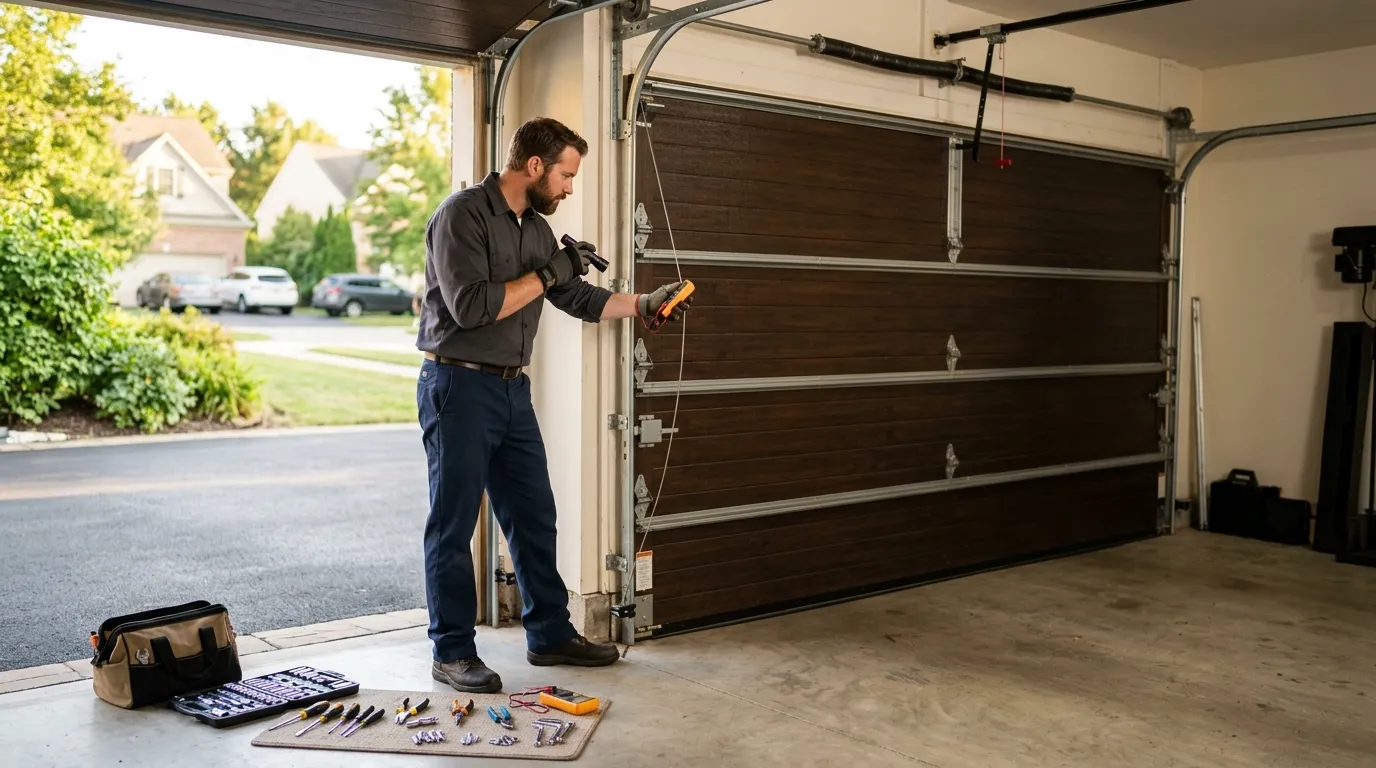
Most doors in La Vergne are steel sectional units on standard torsion or extension springs, because most of the town's houses went up around 2000 - noticeably newer than the 1953-2012 spread you'd find looking at the wider Nashville service area, where the median build year sits closer to 1990. That newer stock means fewer of the oddball one-piece doors and side-mounted hardware you still run into on older streets elsewhere. It also means the failure you're staring at is probably a stock torsion spring, a broken cable, or a opener board that's given up - not something exotic.
If the door won't move and you hear a bang before it happened, don't touch the springs. A wound torsion spring on a standard door still carries enough force to break a finger or worse. If the door is stuck halfway and the opener is straining, unplug the opener and see if the door moves by hand with the opener disconnected - that tells you whether the problem is the door or the motor. If it won't budge either way, stop pulling on it. A door that's off track or has a snapped cable can come down without warning, and a garage door is heavy enough to hurt someone even at a house this size.
We come out from Nashville, about 16 miles down, and the truck carries stock torsion springs, extension springs, cables, rollers, and standard opener parts sized for the sectional steel doors that make up most of what's out there in La Vergne. On a torsion spring break, we measure the door, check the drum and shaft for wear, and replace with the correct wire size and wind - matching, not guessing, because a mismatched spring on a properly balanced newer door throws the whole system out of alignment fast.
On opener failures, we check the logic board, the drive gear, and the safety sensors before we touch anything else, since a lot of "dead opener" calls turn out to be a sensor knocked out of alignment rather than a burned-out motor. We test the balance on every job before we leave - a spring or cable swap that isn't followed by a balance check is a callback waiting to happen.
The jobs that turn into two visits instead of one are usually the ones where the spring wasn't the only thing wrong. A broken spring lets the door drop hard, and a hard drop can bend a track or crack a bottom panel you don't notice until the new spring is in and the door still won't run smooth. On a house from this era, the tracks and rollers are usually original, meaning twenty-plus years of use on the same hardware - worn rollers and a slightly bent track are common enough that we check them before we call the job done.
The other place this goes sideways: openers with circuit boards that are past the point of a simple part swap. If the board itself has failed rather than a sensor or a gear, we're honest that a full opener replacement is usually cheaper and more reliable than chasing a board repair on an older unit. That's not upselling - a fifteen-year-old logic board with parts you can't get anymore just isn't worth patching twice.
Nashville's cold-moderate winters put real stress on torsion springs, and that stress doesn't care what year the house was built - it works on steel the same way everywhere in the service area. What differs town to town is how much load and how many cycles a given spring has already taken. La Vergne's household count sits around 12,880, a good chunk of them owner-occupied houses built in the same twenty-year stretch, which means a lot of springs out there are aging in step with each other. When one goes in a cold snap, it's rarely a fluke - it's a part reaching the end of a normal life cycle at roughly the same time as its neighbors' parts.
Income here runs lower than the broader service area - median household income in La Vergne is around $80,418, versus $93,223across the wider footprint we cover. That's not a reason to skip a repair, it's a reason we tell people plainly when a $40 part fixes it versus when the door actually needs full replacement, instead of defaulting to the bigger job.
The truck stocks standard torsion and extension springs, cables, rollers, hinges, and opener boards sized for the steel sectional doors common on houses built through the 1990s and 2000s - which covers the bulk of what's in La Vergne. What we don't carry on the truck is anything custom: a nonstandard door size, a discontinued opener model, or hardware for an older one-piece door. Those parts sometimes take a special order, and we'll tell you that on the spot rather than pretend otherwise.
We travel from Nashville for these calls, about 16 miles each way, so we load the truck to cover the common failures before we ever leave the shop rather than guessing once we're on site.
We dispatch from Nashville, about 16 miles out, so travel time depends on traffic. We don't quote a fixed response time here since we're not based in La Vergne - call and we'll give you a realistic window before you commit.
Most La Vergne houses were built around 2000, which almost always means a standard steel sectional door on stock torsion or extension hardware. We stock those sizes. Older one-piece doors need special-order parts, but that's uncommon in this part of town.
Not usually. It's often a stripped drive gear or a sensor knocked out of alignment, both cheaper fixes than a motor. We check those first on every call before assuming the opener itself is dead.
If the logic board itself has failed on an older unit, replacement is usually cheaper than sourcing parts for a discontinued board. We'll tell you which situation you're in before doing any work, not after.
Call now or request a free quote - same-day service on most repairs, upfront written pricing.