Nashville, TN · Garage Door Service
Pegram homes mostly went up in the early '90s, not the older stock closer to Nashville. We travel out from Nashville with the parts and springs those doors actually need.
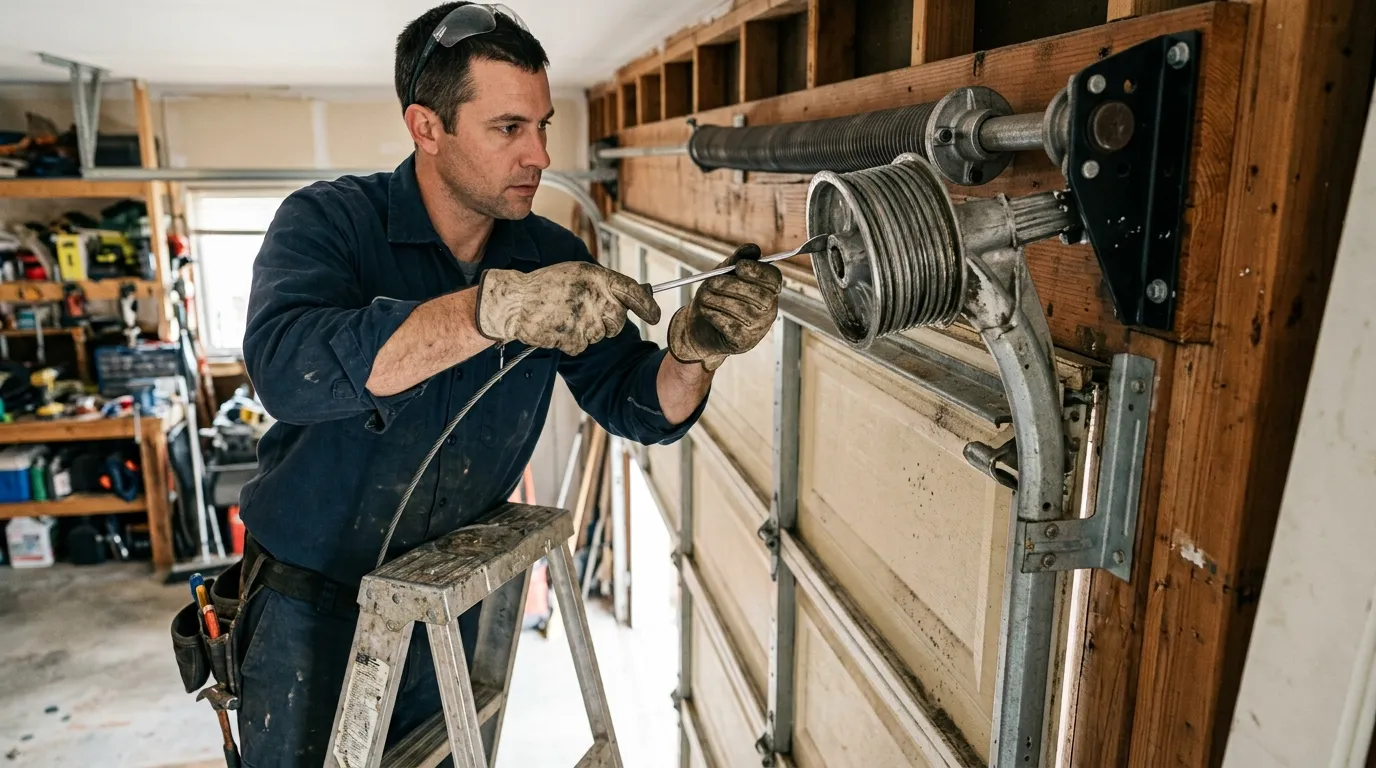
Pegram sits about 16 miles out from Nashville, which is the far edge of where we run trucks. That distance matters for one reason: we don't keep a crew stationed out here, so a same-day call depends on where the truck already is that morning. We're upfront about that instead of promising something we can't back up. What we can tell you is that once we're on-site, the job itself isn't any different than one closer in - springs wear the same way, openers fail the same way, and the drive out doesn't change what parts we carry on the truck. If you're calling about a spring that let go overnight, say so when you call; that's the kind of job we try to bump up the list regardless of distance.
Across the wider service area the housing stock runs from 1953 up through 2012, with a median build year of 1990 - but Pegram itself skews a touch newer, with a median around 1991. That one-year difference sounds small, but it puts most Pegram garage doors solidly in the early galvanized-steel, extension-spring-to-torsion-spring transition era rather than the older side-mounted torsion hardware you still find on some of the 1980s stock elsewhere in the region. Practically, that means fewer of the odd single-spring setups we run into on older homes and more standard 7-foot double-car torsion systems with steel rollers that were factory-installed rather than retrofitted. It also means the openers in a lot of these houses are past their first replacement cycle - chain-drive units bought in the late '90s or early 2000s are now old enough that a board failure is as likely as a mechanical one.
With roughly 863 households in Pegram and a median household income of $102,396, this is a smaller, higher-income pocket compared to some of the denser parts of the broader Nashville area, which runs 55,524 households and a median income of $93,223 across 36,280 owner-occupied houses. What that tends to mean on the ground is fewer builder-grade doors and more owners who upgraded to insulated steel or composite doors at some point after the original install - we see that pattern more in areas with income above the regional median. It doesn't mean every door out here is high-end; it means when something breaks, the owner is often replacing a decent door rather than the cheapest unit that came with the house.
The region sits in a cold, moderate climate band, and a house built around 1991 has now been through three decades of freeze-thaw cycles on its hardware. On a door that age, the failure we see most is a torsion spring that's simply worn out from cycle count, not from cold - springs here don't usually snap from temperature the way they might further north, they just fatigue. Track alignment is the other common one; three decades of seasonal ground movement can pull a track out of true by a few millimeters, enough to make rollers bind. One honest limitation: if the opener is original to a 1991 build, parts for it are getting hard to source, and at some point replacing the whole unit costs less than chasing a discontinued circuit board.
No. We run out of Nashville and cover Pegram as part of that route, about 16 miles out. We're honest that response time depends on where the truck is that day rather than promising a fixed window we can't guarantee for every call.
Somewhat. Pegram's housing runs a median build year of about 1991, slightly newer than the wider service area's 1990 median, which means more factory torsion systems and fewer of the older extension-spring setups you find on some 1980s homes closer to Nashville.
If it's original to a house built around 1991, it's over 30 years old, and boards for units that age can be hard to find. We'll tell you straight if replacement is the cheaper, more reliable route instead of chasing a part that's discontinued.
Call now or request a free quote - same-day service on most repairs, upfront written pricing.